
New study showing tACS for ADHD improves focus.
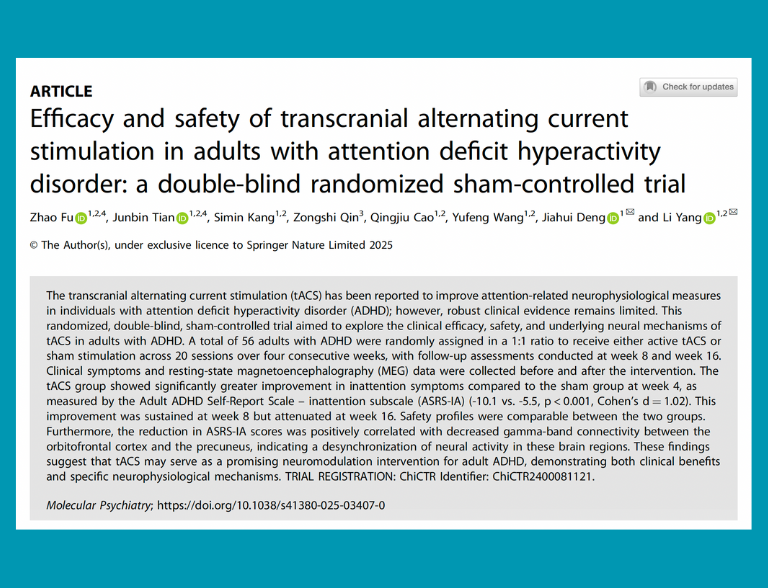
This study in the Journal of Molecular Psychiatry looked at transcranial alternating current stimulation (tACS) to help adults with Attention Deficit Hyperactivity Disorder (ADHD) with 56 adults with ADHD who were split into two groups. One group got real tACS treatment, and the other group got fake treatment (sham). tACS uses small electrical currents to stimulate the brain. The treatment was done 5 days a week for 4 weeks, with 20 sessions total. Researchers measured how well the treatment worked by checking how much the participants’ attention improved using a test called the Adult ADHD Self-Report Scale (ASRS). The results showed that the group receiving tACS had better focus and attention after the treatment compared to the sham group. Their scores improved more, and the effects lasted for up to 8 weeks. The treatment was safe, with only mild side effects like drowsiness or dizziness, and most people completed all sessions.
The researchers also studied brain activity using special scans (MEG and MRI). They found that tACS helped reduce certain brain connections that might be too strong in people with ADHD, which could explain why their attention improved.
Transcranial alternating current stimulation (tACS) is a non-invasive brain stimulation technique that uses low electrical currents to influence brain activity. Here’s how it works:
- How It’s Done:
- Small electrodes are placed on specific areas of the head, such as the forehead and sides of the head (mastoid regions).
- These electrodes deliver a gentle, alternating electrical current to the brain.
- Purpose:
- The electrical currents create oscillating electric fields in the brain, which can help regulate brain activity and improve communication between different brain regions.
- Targeted Brain Waves:
- tACS focuses on specific brain wave frequencies, such as gamma waves (40–90 Hz), which are linked to attention, memory, and cognitive functions. By modulating these waves, tACS can help improve brain functions that are disrupted in conditions like ADHD.
- Safety:
- The electrical currents used in tACS are very low and are considered safe when applied correctly. In this study, the current density was below the threshold for potential brain injury.
- Benefits:
- tACS has been shown to improve attention, memory, and other cognitive functions in people with ADHD, Alzheimer’s disease, and other conditions.
In this study, tACS was used to target gamma brain waves in the prefrontal cortex, which is important for attention and focus. It showed promising results in improving attention. In short, tACS seems to be a safe and helpful treatment for adults with ADHD, especially for improving focus.
